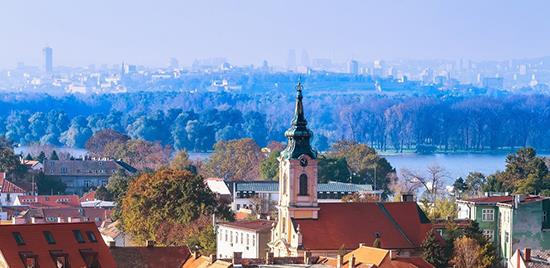
Despite all its historical turmoil Belgrade has an easygoing charm and traditional Balkan charm. Belgrade is literally surrounded by river waters on three sides and therefore since ancient times the city is considered a watchman of river passes. Because of this location it is called the "Balkan Gate" or the door to Central Europe.
Belgrade's climate is temperate-continental. All four seasons are noticeable here. Autumn is the longest with less warm and sunny days. Winter is not very harsh. Spring is short with heavy rainfall. Summer is early and warm.
Belgrade is interesting at any time of the year but the most beautiful in the spring. Spring is also the best time to visit the Serbian capital. At this time the temperature is kept at a comfortable 20 degrees Celsius which provides ideal conditions for long walks and leisurely sightseeing.
Belgrade is the capital of Serbia and one of the oldest cities in Europe and the largest city in the Balkans. It is located at the confluence of the Danube and the Sava rivers in the central part of the country. Belgrade is a center of Serbian culture filled with dynamics, monumental architecture and a tangible history during which it was constantly shaken by wars. Therefore it is difficult to find buildings and structures older than a couple of hundred years old.
Belgrade
History
Belgrade is one of the oldest cities in Europe with a history of more than two thousand years. The most ancient archeological finds discovered in its territory date back to the fifth millennium BC. In the 3rd century BC one of the Celtic tribes here founded the settlement of Singidunum which after several centuries was conquered by the Romans.
The first mention of Belgrade dates from 878 AD. In the Middle Ages the city belonged to Byzantium then Bulgaria and Hungary. Throughout its long and tumultuous history Belgrade has conquered 40 armies and 38 times like Phoenix it was reborn from the ashes.
In the 13th-14th centuries, Belgrade was a border town of Hungary. After the appearance of the Ottomans on the Balkan Peninsula the Hungarians gave it to the Serbs who built strong fortifications here turning the city into a powerful defensive outpost. During this period Belgrade also became the capital of the Serbian Kingdom. Although after some time the Serbs had to return the city to the Hungarians.
In 1440 Belgrade was besieged by a huge Ottoman army. Interestingly the Turks did not immediately capture the city. Belgrade lasted until 1521. After the city became Turkish there was two centuries of peacetime came. In the 17th century with the weakening of the Ottoman Empire Belgrade collapsed. At the end of this century the city was conquered by Austria . Under the authority of the Habsburgs comes a short period of its heyday. In 1739 Austria had to return the city of Turkey .
In the late 18th century, the Serbian National Movement was born. In the first half of the 19th century several uprisings took place in Belgrade. During the second Serbian uprising of 1815, the Serbs enlisted the support of the Russian Empire. This helped them achieve autonomy.
Belgrade was declared the capital of Serbia in 1867 and 11 years later the country gained independence from the Ottoman Empire. During the First World War, the city was occupied by Austria-Hungary. After being liberated in 1918 Belgrade was declared the capital of the Kingdom of Serbs, Croats and Slovenes, later renamed Yugoslavia.

Attractions
Belgrade Fortress is Belgrade's main attraction and one of the symbols of Serbia. This is a significant fortification located at an altitude at the confluence of the Danube and the Sava. The Belgrade Church consists of the upper and lower cities as well as Kalemegdan Park. Kalemegdan in the past was a field where battles took place.
The fortress is a significant historical stratum spanning more than 16 centuries: from antiquity to modern times. The Belgrade Church was founded in the 2nd century AD. Until the 18th century it was destroyed and rebuilt many times. Here the Romans, Serbs, Turks, Hungarians, Austrians left their mark.
The first fortification on the site of the modern fortress was built in the 2nd century AD by the Romans. Then the fortress was devastated by the Goths, Huns, Avars and Slavs. The modern Belgrade Fortress is a powerful outpost the structure of which is built by buildings built by Turks and Austrians mainly in the 18th century.
Ruzice Church is Belgrade's oldest church located near the northeast walls of the fortress of the same name. The exact date of foundation of this temple is unknown. The earliest references to the Church date back to the 15th century. The original church building was destroyed by the Turks in the 16th century. The current building dates back to the 19th century.
Saint Sava Church is the largest Orthodox church in the Balkans as well as one of the largest Orthodox religious buildings in the world. It is a true architectural dominant of Belgrade with a significant height of 79 meters. The church was built on the spot where the Ottomans burned the relics of Saint Sava. This non-Byzantine-style monumental building has been built for almost 70 years (from 1935 to 2004)
Skadarija is one of Belgrade's most beautiful places. It is an ancient quarter with cobbled streets and 18th-century architecture in the past favored by bohemians and now filled with cafes and restaurants.
St. Mark's Church is a beautiful Neo-Byzantine Church, completed in the 1930's. Contains a crypt where 19th-century clergymen and Serbian royalty are buried.
The Republic Square is one of Belgrade's central squares which is the center of a dynamic business district. On the square is the National Theater and Museum. The equestrian statue created by Italian sculptors depicts the Serbian prince Milos Obrenovic (one of the heroes of the national liberation movement).
Prince Mikhailova is Belgrade's main avenue and one of the main shopping streets of the Serbian capital. Here among the beautiful neoclassical mansions you can find many shops, restaurants and bars.
Gardosha Tower is a monument of the Austro-Hungarian period which rises above the right bank of the Danube in the oldest part of the Zemun district of Belgrade. This beautiful building in the style of eclectic architecture was built in the late 19th century to commemorate the 1000th anniversary of the Hungarian settlement on the Pannonian Plain. Right under the Gardosha Tower is a beautiful seafront with sycamore trees and beautiful views of the Danube.
St. Michael's Cathedral is a magnificent neoclassical cathedral built in the first half of the 19th century. The church played an important role in Serbia's struggle for independence so some national Serbian heroes rest here.
The Old and New Courtyards are the former residence of the Serbian Princes and now the official residence of the President of Serbia. The old courtyard was built in the late 19th century in the style of classicism. The New Courtyard dates from the 1930s and has a Renaissance architecture.
The Avala Tower is the tallest structure in the Balkans (135 m) located just a short drive from Belgrade on the hill of the same name. It was built in 1965 for telecommunications. Destroyed in 1999 by NATO bombing of Yugoslavia and restored in 2010.
CityTourism.net is a website dedicated to provide useful and up-to-date information about urban travel locations to its visitors and deliver best possible tips and advice for your future travels. To be able to support and develop our platform and update content regularly we are working with multiple advertisers. Our team would be appreciative if you choose to check out their offers. We do not transfer personal information about our users to advertising companies under no circumstance.
© 2017 CityTourism, Inc. All Rights Reserved