The first written mention of Lear dates back to the 7th century when Saint Hummar was born here. In 1212 the settlement was granted city rights. In 1258 a Running Community was established in Lear a community of women's Order of Runners which is now included in the UNESCO World Heritage List.
In the 14th century the Duke of Brabant John II offered the city two choices of privileges (to help fight Mechelen ): the university or the cattle market. The residents of Lear chose the market after which they received the offensive nickname Schapekoppen (which translates as "sheep heads").
Lier is a charming Flemish city located in the north of Belgium in the province of Antwerp. It is famous for its remarkable historical heritage and its many interesting sights. Lear is a small provincial town the center of which is famous for its beautiful medieval streets and ancient monuments.
Lear is located in the north of Belgium southeast of Antwerp. Through the cities is surrounded by the river Neti. Lear has a temperate maritime climate with cool summers and mild winters.
Lear
History
In 1860,a mammoth skeleton was found at the site of the present town hall. This is the first such discovery found in Western Europe. Unfortunately during the World War I Learon the front lines and badly damaged by the fire of German artillery. Most of the medieval buildings were severely damaged or destroyed. What we see now including the town hall and its bell tower are replicas built shortly after the end of World War I.
Attractions
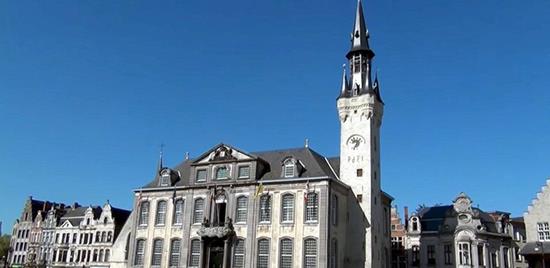
Grotto Markt is the heartbeat of Lear since he was granted city rights in 1212. The square has a triangular shape indicating its Frankish origin. In 1914 3/4 of the historic Grotte Markt buildings were destroyed. The architecture of the square was restored shortly after the First World War.
The Town Hall is the architectural dominant of the Grote Markt. Initially this building was used as a sewing workshop. In the 15th century the garment industry was moved to Vleeshuis (hall of the butchers). In 1740 the town hall was rebuilt in the style of Brabant rococo. The most notable feature of the building is the magnificent Gothic bell tower built in 1369. The bell tower is a symbol of Lear's freedom and independence. In 1999 it was included in the UNESCO World Heritage List.
Zimmer Tower is a medieval tower with a wonderful astronomical clock. This structure was built no later than 1425 and was part of the city fortifications. In 1930 astronomer and watchmaker Louis Zimmer installed a clock on the facade of the tower consisting of 12 clockworks surrounding the central large dial. This clock showed time on all continents, moons, tides and many other periodic phenomena.
St. Gummar's Church is a magnificent cathedral in the style of Brabant Gothic. Construction of the current home began in 1378 and took about two centuries. Therefore the church is intertwined with Gothic, Baroque and Rococo architecture. The most interesting architectural feature of the cathedral is the 83 m high tower. The church tower was built over four centuries. The lower part is Gothic slightly higher is the late Gothic, the upper part is late Baroque and the roof is Rococo architecture. A unique carillon is mounted on top of the tower. To climb to the top you need to climb 296 steps.
Running is a community settlement of the Order of Runners founded in Lear in the 13th century. It is a kind of "city in the city". The run-in includes 11 alleys, more than 150 homes, a 17th-century St. Margaret's Church and a former convent. The entrance to this quarter is emphasized by the monumental blue stone gates built in the late 17th century. To the left of the gate is a medieval statue of Our Lady. Running is included in the list of UNESCO World Heritage Sites.
St. Peter's Chapel is the only Romanesque building in Lear and possibly the oldest. The original chapel built in 1225, replaced the wooden religious building founded by St. Gummar in the 8th century. After the construction of the cathedral opposite most of the chapel was demolished. Unfortunately this building was burned down during World War I and was rebuilt in 1922.
St. James's Chapel dates from the 14th century but has been rebuilt and rebuilt many times over its long history. In the 17th century it was used as a parish church for Spanish troops stationed in Lear. Hence the name - "Spanish Chapel".
The Fish Market is an important historic area in Lear. Here you can see the Old Water Pump of 1835 and the Tower of Bakery 1393 (Bakkerstoren), which housed a prison until the 16th century.
The Butchers' Hall (Vleeshuis) is a historic building dating back to 1418 which now has a Gothic architecture. Throughout history there have been located: town hall, court, prison.
The Nazareth Abbey is a medieval monastery founded in 1236 and destroyed in 1797 during the French Revolution. Only the entrance gates remained intact.
The prisoners' gates were built in 1375 as part of the first city wall. These are the only preserved gates of the medieval Lear. From the 16th century until 1930 they were used as a prison. They have a gothic structure with elements of classicism.
Fortuna House is a historic 17th century building on the banks of the River Neti. Used as a grain warehouse then as a coal warehouse and carpentry workshop.
Almshouses are medieval charities built in the late 16th century. At this time, these small houses are for rent.
How to get there
Lear has regular rail and bus connections with a number of major Belgian cities including Antwerp, Mechelen and Brussels. Lear is easy to reach by car.
The city is located midway between E19 ( Antwerp - Brussels) and E313 (Antwerp - Liege).
CityTourism.net is a website dedicated to provide useful and up-to-date information about urban travel locations to its visitors and deliver best possible tips and advice for your future travels. To be able to support and develop our platform and update content regularly we are working with multiple advertisers. Our team would be appreciative if you choose to check out their offers. We do not transfer personal information about our users to advertising companies under no circumstance.
© 2017 CityTourism, Inc. All Rights Reserved